
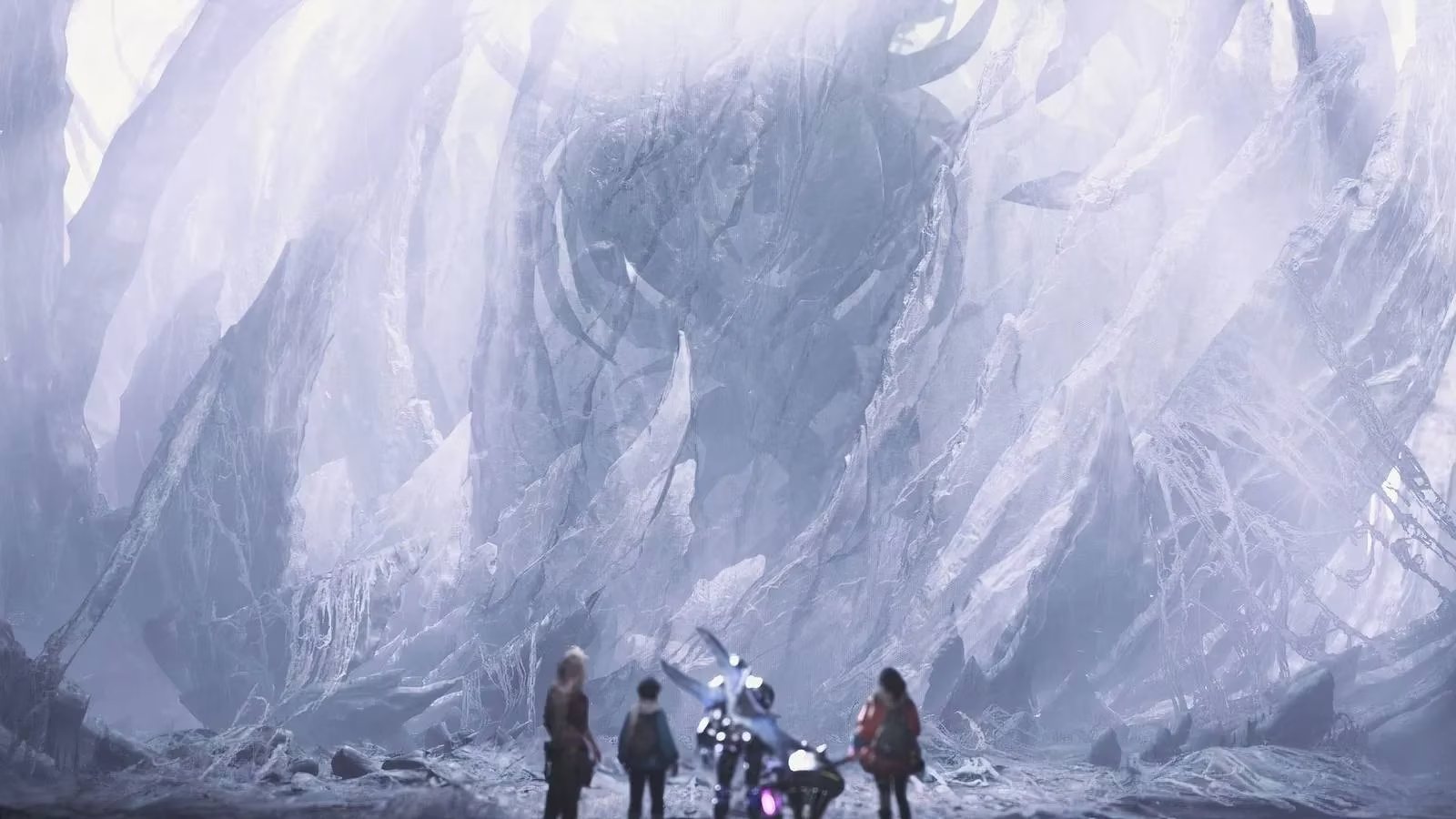
Monster Hunter Wilds stands among the most narratively dense entries in Capcom’s long-running hunting series. Beyond its accessible combat and vibrant ecosystems, the game deepens its post-apocalyptic setting through the ancient Artian civilization, Wyvern Milk, and the watchful presence of handler Alma. Among the many mysteries left for players to interpret, the most persistent concerns Zoh Shia, the final pre-credits encounter of the main story. This pale, dormant creature is first glimpsed coiled in a hidden chamber, quietly siphoning energy while it sleeps. It retaliates only when approached, leading many hunters to wonder what exactly it is, where it came from, and why it shares traits with some of the franchise’s most infamous elder dragons.
Guardian Monsters and Ancient Bioengineering
Within Monster Hunter Wilds, the term Guardian refers to creatures created by an ancient civilization to serve as protectors. The narrative makes clear that most Guardian monsters are engineered replicas of existing species, built around recognizable templates. Zoh Shia, however, disrupts that pattern. Its appearance is unlike any known species, and its behavior suggests a unique origin. Rather than being modeled on one single living monster, it appears to function as a composite organism, assembled from multiple evolutionary lineages. This has led to widespread fan speculation that Zoh Shia is not a natural species, but a synthetic apex weapon created by the ancient Artians.
The Amalgamation Hypothesis
Early theories proposed that Zoh Shia is an amalgamation of several powerful monsters. The evidence comes primarily from its attack patterns, which borrow from a wide array of legendary foes. Observers catalogued its move set and noted echoes of:
-
Fatalis, including three distinct attack styles associated with different versions of the black dragon
-
Safi’jiiva, the red dragon known for energy absorption and bioenergy manipulation
-
Shara Ishvalda, the earth-shaking dragon with sonic and vibration-based attacks
-
Gaismagorm, the abyssal creature connected to the Qurio
-
Alatreon, the unstable elder dragon capable of shifting elemental properties
A creature that contains combat traits from so many separate species strongly implies deliberate construction. Ancient scientists may have harvested genetic material or behavioral data from each monster and fused them into one guardian.
The Fatalis Connection: Ocular Evidence
A more specific discovery has recently strengthened the theory that Fatalis forms the main genetic backbone of Zoh Shia. During the second phase of the fight, Zoh Shia reveals its eyes for the first time. Players quickly noticed that these eyes are strikingly similar to those of Fatalis. Both monsters display yellow eyeballs with a black, diamond-shaped slit running vertically through the center. This distinct ocular anatomy is rare among the series’ creatures, making the resemblance difficult to dismiss as coincidence.
This observation, shared by a player named JackNewbie555, gives visual support to the idea that Fatalis DNA is not just one ingredient among many, but the primary foundation of Zoh Shia. The term often used by the community is that Zoh Shia was built around Fatalis as a base template, then modified with components taken from other powerful beasts.
Supporting Details at a Glance
| Trait | Observation | Implication |
|---|---|---|
| Move set | Includes attacks from Fatalis, Safi’jiiva, Shara Ishvalda, Gaismagorm, and Alatreon | Composite genetic or behavioral origin |
| Eye structure | Yellow eyes with a black diamond-shaped pupil slit, revealed in phase two | Strong phenotypic match with Fatalis |
| Guardian role | Created by the ancient Artian civilization as a protector | Artificial bioengineering rather than natural evolution |
| Dormancy | Hid away for years while siphoning power | Designed for long-term energy storage and defense |
Lore Implications for the Series
The possibility that Zoh Shia is primarily a Fatalis-based construct has large implications for Monster Hunter lore. Fatalis has long been treated as an apocalyptic force, a dragon whose presence in myth signals destruction and rebirth. If the ancient Artians managed to replicate and even augment Fatalis traits, it reveals how advanced their biotechnology had become. It also raises unsettling questions about why such a creature was sealed away. Zoh Shia may have been a last-resort weapon that grew too dangerous, or a guardian created to oppose some forgotten threat.
As fan analysis continues into 2026, the official origin of Zoh Shia remains unconfirmed by Capcom. Nevertheless, the combination of shared attacks and matching ocular features offers one of the most convincing explanations yet. Zoh Shia seems to be more than a simple guardian: it is a living archive of the series’ most dangerous monsters, with Fatalis written into its core.